A warm welcome to your new website
We’ve made improvements to help you find what you need more easily. If anything doesn’t work as expected, please let us know using the feedback button below.


Land management rules on dogs, paths, wild camping, barbecues and fires
We all need space outdoors to unwind and recharge, including wildlife. Whether you are on land or water, we want to ensure that recreation and nature conservation can work together for everyone’s benefit.
Our coastline is busier than ever and one of the main threats wildlife faces is disturbance. Put simply, disturbance is when the presence of a person, or their pet, causes an animal to change its behaviour. This might mean running or flying away. On busy beaches and popular walking spots, they might spend much of their day alert and stressed or on the run. This leaves little time for feeding and restoring energy, which can significantly reduce their chances of survival. Reducing the impact of recreational activities on wildlife is essential to ensuring its future.
By making simple changes you can enjoy East Lothian’s coast and countryside, whilst also protecting its wildlife.
About 75% of our coastline and some inland sites are designated as a Site of Special Scientific Interest (SSSI) and RAMSAR site for its wetlands to protect the nationally significant shorebird populations and the vital habitats that they use for feeding and roosting. In addition to this, the Firth of Forth is also a Special Protection Area (SPA).
Keeping boots, paws, bikes and hooves on paths can make a massive difference, giving wildlife space to rest and feed undisturbed.
East Lothian Council has a duty under the Land Reform (Scotland) Act 2003 to uphold and promote access rights. To do this and ensure those accessing the land behave responsibly, we have introduced Land Management Rules for Countryside Sites, Parks, Nature Reserves and Greenspaces. Access rights are fully explained in the Scottish Outdoor Access Code. East Lothian Council in exercise of the powers conferred on them by Section 112 of the Civic Government (Scotland) Act 1982 hereby make the following Land Management Rules for the council’s Countryside Sites, Parks, Nature Reserves and Greenspace.
1. No person shall in any countryside site, park, nature reserve or greenspace wilfully obstruct, interrupt, interfere, impede or insult any council official in carrying out their duties.
2. Persons using countryside sites, parks, nature reserves or greenspaces shall not wilfully obstruct, interrupt, interfere, impede or otherwise disrupt the enjoyment of others also using the site, park, nature reserve or greenspace. Such behaviour may include, but will not be limited to: using amplifying noise equipment, such as speakers in a way that adversely impacts other users of spaces; using model aircraft, motorised drones, toy cars, boats or any other such motorised toy or model vehicles in a way that adversely impacts other users of spaces.
3. No persons with control of a dog or dogs shall allow said dog to enter any area in any countryside site, park, nature reserve or greenspace that has been designated as a dog free area, whether that designation is temporary, seasonal or permanent.
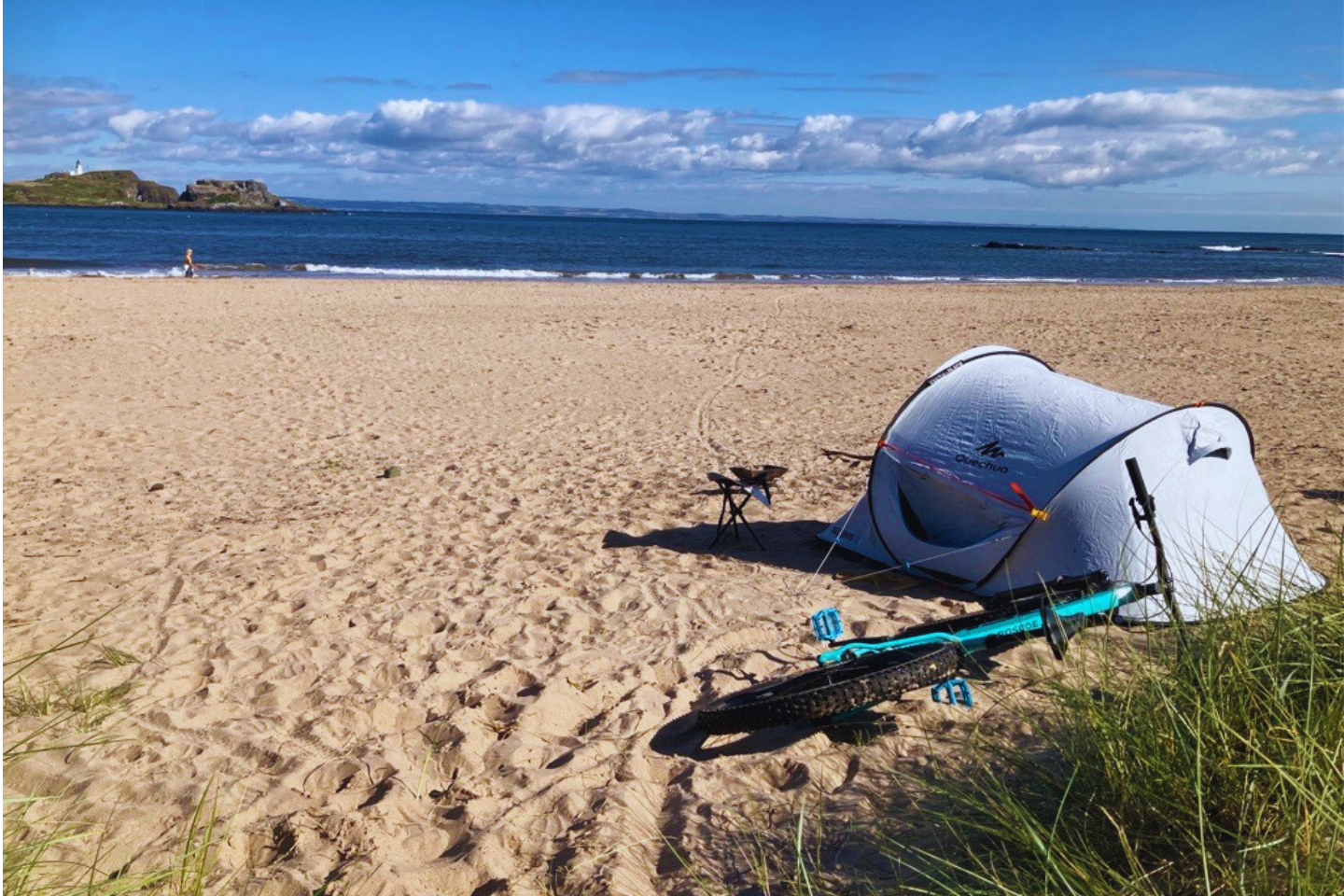
All wild camping as defined in the interpretation section and online at www.eastlothian.gov.uk/wild-camping must be carried out within the confines of the rules in both this and the proceeding sections.
4. wild camping is the only kind of camping allowed outside of designated campsites.
5. When wild camping, all camping equipment and accessories must be cleared away once the campsite is no longer in use.
6. When wild camping, any barbeques and fires must not be lit in areas where vegetation could be scorched, burnt or otherwise damaged, or when a high fire threat has been declared. Any barbeques or fires lit must be kept within close control and active observation at all times. All fire and barbeque debris, detritus or refuse must be cleared away once the fire or barbeque is no longer required and is safe to be cleared away.
Any person who appears to be breaking, has broken, or is about to break any of the following Rules can be asked by a council official to leave the area. Any person refusing to leave will be guilty of an offence and liable on summary conviction, to a fine not exceeding level one on the
standard scale.
7.1 Where a council official has reasonable grounds for believing that a person as contravened, is contravening or is about to contravene any of these Management Rules, they may expel or ask to leave that person from the area.
7.2 Where a person has persistently contravened or attempted to contravene these Management Rules and in the council’s opinion is likely to contravene them again, the council may decide to make that person subject to an exclusion order for a specified period of up to one year.
7.3 An exclusion order made under Rule 7.2 shall take effect on such date as the council may decide, being not less than 14 days after the decision to make that person subject to an exclusion order. A person who has been made subject to an exclusion order:
i) shall be entitled to written notice of the decision to make the exclusion order, containing a statement of the reasons for that decision, and
ii) shall be entitled to make written or oral representations to the council at any time up to the time that the order would have taken effect but for the representation being made.
Give your feedback about the website
We welcome your feedback on all our services: make a comment, complaint or suggestion.