A warm welcome to your new website
We’ve made improvements to help you find what you need more easily. If anything doesn’t work as expected, please let us know using the feedback button below.


Burial services and information about cemeteries and headstones.
East Lothian Council is committed to ensuring the safety of all visitors, staff, and contractors in our cemeteries. We have a legal duty to maintain cemeteries in a safe condition.
As part of this duty, we carry out regular inspections of headstones and memorials, typically on a five-year cycle, in line with national guidance and best practice.
Each memorial is assessed by a trained member of staff. Where a memorial is identified as unsafe or requiring attention, a warning notice will be placed on the headstone to inform the lair holder.
Any headstones found to be unstable will have a sign (pictured) fixed to the stone by plastic banding or zip ties advising the lair owner the headstone is unsafe:
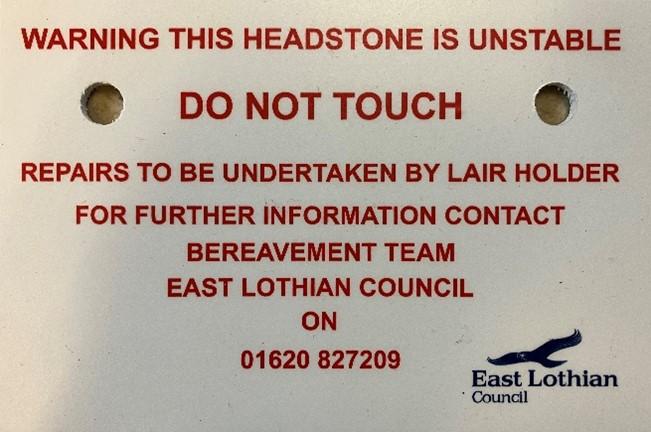
This sign will be affixed to unsafe headstones.
We understand this may be unexpected and may cause concern. We apologise for any distress this may cause; however, public safety remains our priority.
These inspections are carried out in accordance with current legislation and recognised guidance, including:
These inspections are carried out in line with national legislation, including Section 4 of the Burial (Management) (Scotland) Regulations 2025, which requires burial authorities to ensure memorials are safe
The Health and Safety at Work etc. Act 1974 places a legal duty on the Council to ensure, so far as reasonably practicable, the safety of staff and members of the public.
Under the Occupiers’ Liability (Scotland) Act 1960, the Council has a duty to take reasonable care to ensure that visitors are safe when using cemetery grounds
Scottish Government guidance on Burial Ground Memorial Safety, which supports councils in safely managing and inspecting headstones and memorials
East Lothian Council’s cemetery regulations, which explain how burial grounds are managed and maintained
Inspections are undertaken in accordance with guidance from the Institute of Cemetery and Crematorium Management (ICCM), which provides nationally recognised standards for assessing the safety of headstones and memorials.
A memorial may be considered unsafe if:
Many older memorials were installed without modern fixings and can become unstable over time.
A headstone that appears to lean is not always unsafe. These are monitored and reassessed where required.
Inspections include:
If the memorial moves excessively under pressure or poses a risk of falling, it is classified as unsafe.
If a memorial is identified as unsafe, a warning notice will be attached.
If no action is taken, the Council will make the memorial safe. This is not a repair.
Depending on the size and condition of the memorial, this may include:
Temporary supports may include wooden posts and banding. If repairs are not carried out within the allowed period, the memorial may be made permanently safe by securing it into the ground or laying it flat.
In some cases, areas may be temporarily cordoned off for safety. Please do not enter these areas.
These safety measures are reversible, and the memorial can be reinstated at any time by a qualified memorial mason.
The lair holder is responsible for arranging any necessary repairs.
To do this, you must:
The mason will apply to the Council for the required permit before any work is carried out.
Repairs must only be carried out by a qualified mason.
Do not attempt to move or repair a memorial yourself, as this may result in serious injury or damage.
You can find accredited masons at:
Using a qualified mason ensures that:
If the lair holder has passed away, a Declaration of Transfer for Right of Burial must be completed before any work can take place.
For guidance on the inspection and the process, please contact the Monument Enquiries Team
Please note: We operate an appointment-only service. If you wish to meet a member of the Bereavement Team in person, please call or email to arrange an appointment. We may not be able to see you without one.
Give your feedback about the website
We welcome your feedback on all our services: make a comment, complaint or suggestion.