Pest control

Bedbugs

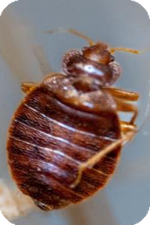
Image of a adult bedbug

Adult bedbugs are reddish brown in colour and are roughly the size of an apple seed, they are oval-shaped flat insects that bodies balloon after feeding. 

Nymphs (young) are smaller, translucent or whitish yellow and become darker as they mature. 

Bedbugs lay eggs and these eggs are tiny pearl white in colour and are grain shaped. They are often found in clusters, tucked into cracks, crevices, and mattress seams. Eggs are sticky to the touch and will not fall off a surface easily when brushed or shaken.

Bedbugs feed exclusively on blood, normally every 3-4 days and generally only in darkness. Bedbugs can survive extreme starvation and have been known to survive for up to 12 months without feeding.

Although human blood is preferred, they can survive on blood from rabbits, dogs, cats and rodents etc. The close association of bedbugs with humans can cause a substantial nuisance through the blood feeding habits. 

Pest Control - Bedbugs

Bites

Bites are small and red and are typically found on exposed skin such as face, neck, hands, arms and legs. Although bites may be itchy try to avoid scratching as this could cause a secondary infection. If infestation is high, then there can be a risk of anaemia. 

Bedbugs are not known to be carriers of human disease.

Signs of an infestation

Bedbugs are nocturnal insects and can be found wherever humans sleep within a property. 

They can be found in mattress seams, box springs, bed frames, headboards, and behind baseboards but can also be found hiding in areas such as floor cracks, under carpets, behind loose wallpaper or pictures, loose skirting boards and door frames, and the surrounding structures of infested rooms.

Sightings – of live or dead bedbugs, eggs or shell-like castings.

Faecal marks - dark, ink-like spots can be confirmed as faecal spots if they turn reddish-brown when dabbed with a wet cloth often found on bed linen, soft furnishings and bed frames.

Smell – in sufficient numbers an unpleasant almond-like smell may be detected in infested rooms.

Causes of an infestation

In luggage - can be carried into the home in luggage after a stay in an infested hotel or dwelling. 

Second hand furniture - can enter the home on second-hand furniture.

Clothing - in very rare cases, can be brought in on a person's clothes.

Nearby infestations - modern buildings often allow bedbugs to migrate along terraced houses and between flats, spreading the problem away from the original infestation.

Preventative measures

Maintain your home – vacuum regularly ensuring to empty and dispose of vacuum bags and reduce household clutter (mainly bedroom clutter).

When travelling - inspect your hotel room for bed bugs, particularly on mattresses and headboards. Keep suitcases off the floor and away from the bed. Upon returning, check your luggage and wash all clothing on hot, high-heat settings. A 60 degree wash will kill eggs, nymphs and adult bed bugs.

When buying used furniture - inspect used furniture, especially beds and sofas, for signs of bedbugs before bringing these into your home.

Treatment of bedbugs

Self-treatment is very rarely successful, and we would always recommend contacting a professional pest control contractor who will carry out a thorough treatment.

The standard treatment for infested premises is the application of an insecticide approved for use against bedbugs. The insecticide should be applied to all cracks and crevices where bedbugs could be hiding, including the crevices of bed frames, flooring, skirting boards, etc. All bed linen should be washed at the hottest temperature that the material will allow, a 60 degree wash will kill eggs, nymphs and adult bed bugs.

It is recommended to avoid vacuuming for seven days after treatment and it is important to monitor for several weeks to ensure that the treatment has been successful.